
Tristan Forever wins Golden Horn

Event image showing the presentation ceremony at the 2026 Krakow Film Festival
The 66th Krakow Film Festival, which ran in cinemas from 31st May announced its winners on 6th June, with Swiss documentary Tristan Forever, directed by Tobias Nölle and Loran Bonnardot, taking the Golden Horn prize in the International Documentary Competition.
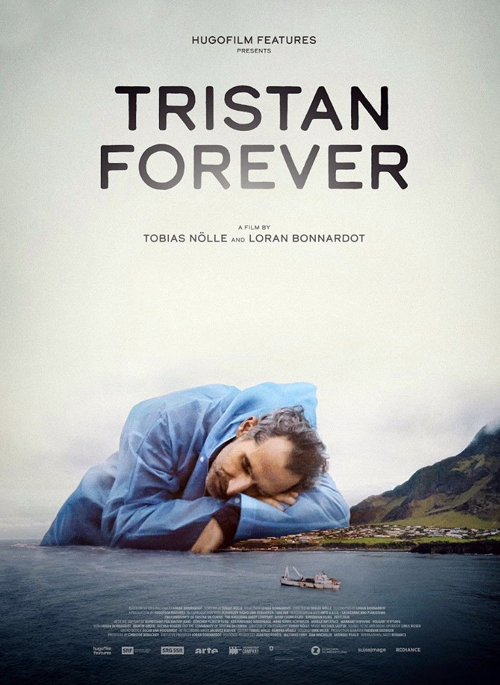
Main Tristan Forever poster
The jury's verdict stated:
Through its unique cinematic vision and poetic, hybrid form, this film examines the inner conflict between a person and their imagined self, exploring the universal longing for home and identity. Pushing the boundaries of creative documentary cinema, the film - by virtue of its originality, sensitivity, and emotional depth - travels through time to reflect upon the relentless impatience of human nature in the face of societal expectations. For this outstanding artistic achievement, we award the Golden Horn to Tristan Forever.
For more about the film Tristan Forever see also:
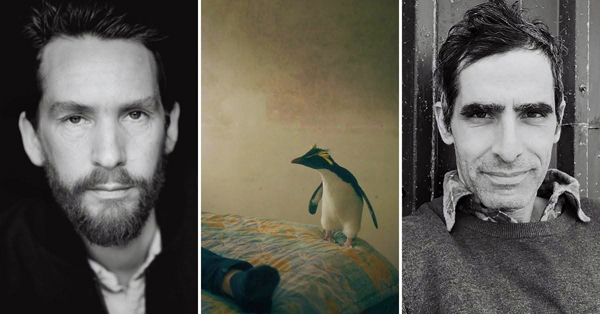
Trio of images showing, left to right: Tobias Nölle, Scene from the film, Loran Bonnardot.
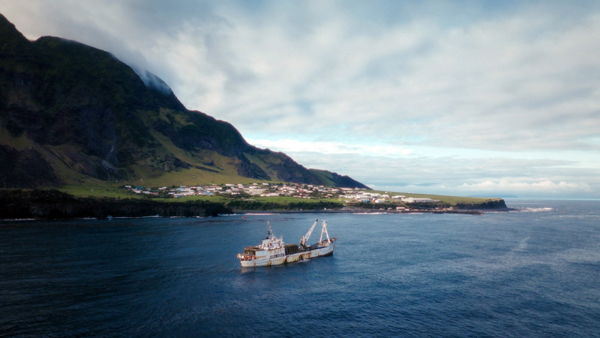
Drone footage from the film showing MFV Edinburgh with the Tristan Settlement behind
We reproduce below extracts from a review by Nick Cunningham with his permission,
first published on www.businessdoceurope.com:
It seems like an odd choice. Tristan da Cunha may be the most remote inhabited island on the planet, situated in the Atlantic between South America, Africa and Antarctica, but it is nevertheless the place where Loran Bonnardot, a piano-playing doctor from Paris, is determined to settle. Director Tobias Nölle follows Loran on his existentialist adventure in the feature Tristan Forever, a part-fictionalised documentary which won The Golden Horn for Best Film in International Competition at Krakow 2026. The film world premiered in Berlin Panorama earlier this year.
The film's hero has known Tristan da Cunha for 30 years, and has maintained a close friendship with Martin, a fisherman on the island which has a mere 230 residents and is only accessible 6-8 times per year by boat, such is its remoteness.
What's more, the place has a strange Britishness about it, being one of the three islands that comprise the British Overseas Territories within the Southern Atlantic.
These days, the folk on Tristan da Cunha speak with a clipped accent straight out of 1950s post-War British cinema - at least in the presence of director Nölle. "They automatically switch when there is a person like me around because they're so polite and they go into more understandable English, but when I step away … I know I speak pretty well English, but I could not understand really a word. It's really a strong accent."
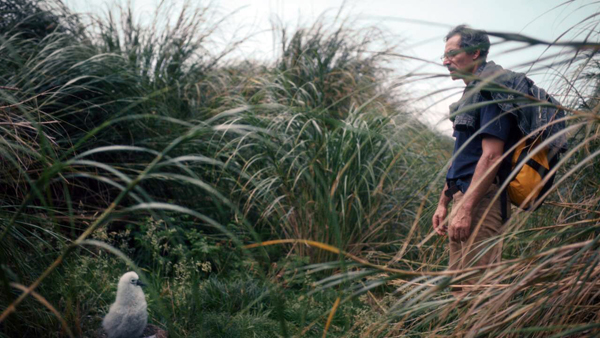
A film scene shot on Nightingale Island showing Loran amongst the tussock grass looking at an Atlantic yellow-nosed albatross or molly chick.
For Loran, there are a series of dilemmas to overcome. He needs to be accepted for permanent residency status by the island council. What's more, he no longer wants to practise medicine, even though his services may be called upon from time to time. And he wants to find a partner. Shopkeeper Glenda, a recent divorcee and someone whose accent Loran has no problems understanding, shows willing, and indeed he seems interested in her. But she wonders if he will actually stick around in such a remote place and is therefore hesitant to commit.
What's more, Loran can be somewhat hapless, and a bit of a liability. He's a loner who keeps getting lost on the island and has to be rescued on more than one occasion. And when he leaves candles burning in his remote hut after a romantic dinner date, fiery mayhem ensues.
So, little by little, the previously optimistic former doctor from Paris settles into a state of unease, maybe even depression, and begins to wonder whether his island odyssey is a passing fancy or a lasting commitment …
When Swiss director Nölle was approached to direct the film, he was immediately captivated. "I saw in Loran a castaway from our hyper-competitive society, seeking an authenticity we've lost, on an island secluded from our war-torn world; a dream I wanted to transform into a cinematic experience," he says in his film notes.
He adds: "I was immediately drawn to Loran as a character … When I met him he felt unique and I was very interested in filming him. If he would have been just a common doctor who wants to move to the Bahamas, I would not have been interested. But he really gave me the feeling of an extraordinary person through his work with Doctors Without Borders (Médecins sans frontiers.)"
"He has a physiognomy you want to film," Nölle adds. "It's like he could be an actor, and the way he talks and his passion, almost obsession, with this island was very unique, so he came to Berlin. We went for a walk, and he just said a few things, one thing [being] that he's not sure sometimes if Tristan really exists or if it's just his imagination. I thought, okay we could find common ground there."
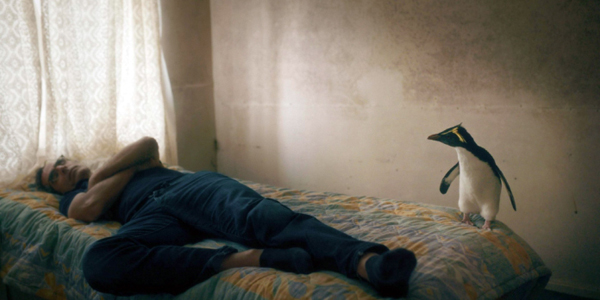
The iconic main image used to promote the film which shows a melancholy Loran observed by a Northern rockhopper penguin, common in the Tristan Settlement when moulting after Christmas.
For Nölle, another area of common ground was the notion of belonging. "You know, the question of where we belong is something that is part of my life. I studied and lived in the United States, then I lived back home in Zurich, now I live in Berlin and maybe I'm still gonna live somewhere else at some point. This question of where you belong is just something that helped me to connect to him instantly."
The film contains fascinating archive from 1961 when the island's residents had to be evacuated after a volcanic eruption. When they arrived in the UK, the evacuees sounded more British than their hosts, but after two years away they were determined to return, liking neither the British weather nor the "sickness" that they observed. (Incidentally, the production of Tristan Forever was delayed for three years during the pandemic, when all movement back and forth to the island was put on hold.)
Animals play a major role in the film, whether they be sheep descending a steep hill-top in line, or three curious donkeys. We see albatross chicks emitting strange clucking noises from their beaks and there is even a very friendly penguin that follows Loran everywhere and keeps guard even as he sleeps.
"I think animals are always an important part of my films," says Nölle. "There's always animals' kind of observing at some point what the main character is doing, and on Tristan there are just many more animals, and they're really coexisting, they are living there with the humans … I love to film animals just because they're really good actors and have this mystery. It feels like they know everything."
Documentary purists may bristle at some of the fictionalised aspects of the film, but it was never the intention of Nölle, himself a mainly fiction director, to make a pure documentary.
"I just followed my instincts and tried to come home with material that I could make a story [out of], but from the beginning it was the concept to mix the two [documentary and fiction] and I hope that it's also enjoyable," he tells BDE, adding how Swiss funding for the film came both from the documentary and fiction pots.
"I think it's up to you if you want to decide what is real and what is not. Honestly, also for me it's very difficult to say, because even if we had a staged scene it was happening in such a real environment and it went completely different as planned and it's all real characters from the island who play themselves. Loran also plays himself, so the border for me is like a haze. But that was the goal of the film, to be in this in-between stage somewhere between dream and reality, fiction and documentary, so it's really up to you. Some people think the whole film is a fiction and some people think the whole film is a documentary, and I think that's nice."
"I worked with these Tristanians and with Loran as non-professionals and it was just incredible … and I think more and more to integrate more non-actors as well and just put people more in situations that I haven't planned out," he adds. "You know, I used to be a bit afraid and plan everything and write it all in the script, but with this film I realised the best sometimes is when you don't know. You just have an instinct and a feeling, and you follow that, and maybe it goes in another direction but to let yourself be surprised instead of having it all planned out is great."