tristandc.com
The Tristan da Cunha
Website
tristandc.com / index / news / newsconservation
Conservation News
News Home Page
Website Home Page
Conservation News 2005-8

Free Willie
Freeing Willie the Humpback Whale
an amazing Tristan rescue success from Conrad Glass

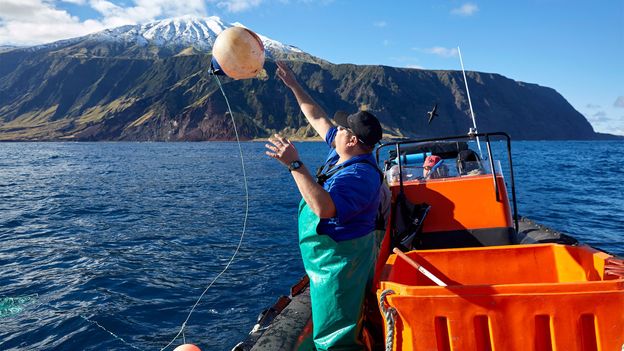
On Tuesday 29th November factory manager Erik McKenzie spotted a whale with a buoy and net caught around its tail about 200 metres off Calshot Harbour. Erik alerted Sean Burns who contacted Conrad Glass to assemble a Search and Rescue crew. Conrad was joined by Neil Swain, and Conrad's son Leon who left the harbour at 12.15 to investigate, carrying with them a boat hook and knife to attempt to free the whale. Sean Burns went along as photographer.

Photos from the RIB
by Sean Burns:

Left: approaching the stricken whale
with its head visible
and the buoy around its tail.

Right: Leon reaching out and cutting the netting around the buoy.

Conrad takes up the story:

We were directed towards the whale by Eric from on top of the cliff via VHF radio. Sean kept radio contact; Leon stood by with knife in hand; while Neil stood in the bows holding on to the painter (bow rope) with one hand, the boat hook ready in the other.

Suddenly Neil pointed with the boat hook and shouted “Thar she blows”: 20 meters in front of the RIB, the whale surfaced, pulling a fishing buoy with a short stick attached. The buoy was about six metres behind the whale. I increased speed to catch the whale and steered the boat along side of it. The whale was a humpback, about eight meters long and about two meters wide.

We made several approaches, trying to get as close as possible to identify the amount and type of fishing line – (were any hooks attached?) and gauge how close we could get to the whale, which was very stressed. Each time we approached, the whale would dive deeply, taking the buoy so far under the water with what appeared to be hardly any effort – indeed, going so deep that we could not see it. Both Neil and I were rather cautious in how we were going to attempt any rescue when we saw the size and actions of the whale.

The whale would remain under for about five minutes before re-surfacing again. As soon as we approached, it would dive deeply again. “This is not giving us much time to hook onto the line and cut it” I said. “I don’t see how we can cut the line if the whale keeps diving”. Neil said: “Guys: we have to do something to help”. Sean said the concern was apparent in his voice.

Neil added: “If we can get the buoy cut off the rest of the line, it may work fee itself”. Leon pointed out: “It’s the buoy that's keeping the line taut, as the whale swims or dives, the line keeps the tension on the line”.

I looked at Neil and Leon: “Right! lets do it; when the whale surfaces this time I will get close to it then let the RIB’s momentum carry us close. Hopefully it will not force it to dive”. We waited for a few moments: “There it is” said Leon, pointing to the whale that had just surfaced 10 metres on our port side.

I quickly turned the RIB, cutting back to get behind the whale, then turning to allow the RIB to coast forward. Neil hooked onto the buoy with the boat hook, and quickly lifted it into the RIB with a mass of tangled line. “Now cut the line quickly” I said to Leon, who was standing on the port bow, but had to move to starboard bow to get at the fishing line.

“Watch out for the fish hooks” Neil told Leon, as he frantically sawed at the line. First Leon cut the buoy loose, then Neil pulled another handful of tangled fishing line with a large hook attached and cut this. Neil said to Leon: “ I think the single bit will come free” and “hold the line taut” Leon responded as Neil pulled more slack into the boat to be cut off.

During this time I nudged the RIB closer behind the whale until we were about two meters from its tail. The strange thing is the whale seemed to sense that we were helping it, for the creature remained hardly moving. As Neil let go of the last bit of line, the whale dived deeply, swimming out to sea. Sean got some photos of this.

Neil said that he could not see any other tangled line about its tail, so any single bits should work free. We identified the buoy, line and hook to be from a Japanese or Taiwanese long-line fishing vessel. Some of these lines are about sixty miles long. No doubt the whale got caught in one of the broken lines. These vessels fish illegally in the South Atlantic, We turned back to the harbour to clear immigration on the yacht “Setna” which had just arrived and had been told to keep clear of the whale while it had the buoy attached.

I must add that the fishing line and buoy caught on the whale did not belong to Ovenstone Agency Ltd, the fishing company who have the contract to fish for crayfish in Tristan waters. Of all the rescues I have been asked to organise, freeing “Willie the Humpbacked Whale” rates the most unique by far!

Conrad Glass MBE is the author of Rockhopper Copper which relates many real-life stories. Perhaps when the book goes into its third edition this 'Free Willie' story will be included?

Above and Centre:
The freed whale swims away
Above:
The victorious crew of Leon, Neil and Conrad showing the 'ghost' gear abandoned by a poacher fishing crew that had ensnared the humpback whale

About Humpback Whales

The humpback whale (Megaptera novaeangliae) is a species of baleen whale. Adults range in length from 12–16 metres (39–52 ft) and weigh approximately 36,000 kilograms (79,000 lb). The humpback has a distinctive body shape, with unusually long pectoral fins and a knobbly head. It is an acrobatic animal, often breaching and slapping the water. Found in oceans and seas around the world, humpback whales typically migrate up to 25,000 kilometres (16,000 mi) each year. Humpbacks feed only in summer, in polar waters, and migrate to tropical or sub-tropical waters to breed and give birth in the winter. During the winter, humpbacks fast and live off their fat reserves. The species' diet consists mostly of krill and small fish. Due to over-hunting, its population fell by an estimated 90% before a whaling moratorium was introduced in 1966. Stocks have since partially recovered; however, entanglement in fishing gear, collisions with ships, and noise pollution also remain concerns. There are at least 80,000 humpback whales worldwide.

Whale of a Tale


Report of a rare visit by a whale to Calshot Harbour

from James Glass

On the morning of the 19th January 2011, there was much excitement when it was reported by David Swain, who was working on a barge at the time, that a whale was in the harbour. It seemed impossible at the time, given that the harbour is less than 2m deep in places, but it was true. The harbour quickly become busy with everyone who had heard came for a look, the school children as well as others in the community.

Plans were put in place to try and get the whale (which was badly damaged) out of the harbour as quickly as possible. James and Robin, with the help of others got the Zodiac out of the boat house and was about to launch it when, Thomas Lafaille a Frenchman working for the CTBTO, who had a wetsuit in his car at the harbour, entered the water and after a few attempts managed to head the whale out to sea, through the 50ft entrance of the harbour. The whale beached itself again west of the volcano, and again managed to get off.  It has not been seen stranded again to date.

Photograph from James Glass
of the stranded whale
From the photos taken and sent to experts, it is thought to be a short-headed sperm whale (Kogia sp), which has not been recorded from the Tristan area before. There are two species, the pygmy sperm whale Kogia breviceps and the dwarf sperm whale Kogia sima. They are quite difficult to tell apart, but the pygmy is bigger (up to 3.3 m, compared to 2.74 m for the dwarf) and the dorsal fin is nearer the tail than the head, whereas in the dwarf it is about in the middle of the body. There are other differences but we would need other views of the mouth, teeth, dorsal fin, etc. However they are reasonably sure it is a pygmy sperm whale from the pictures we sent. These tend to be repeat stranders, so if it happens to be washed up dead somewhere! We may find it to be something else.

RSPB's Brad Robson's work with Tristan's Conservation Department


Brad Robson arrived on Tristan in mid-December 2008. His work on Tristan is part of the European Commission’s EDF-9 funded South Atlantic Invasive Species Project, and he is one of four project officers based in the South Atlantic. His focus is on the delivery of the Invasive Species Action Plan, developed by the Tristan Conservation Committee in May 2007 and working with Trevor Glass, the Conservation Officer.

Photo shows right to left :
Brad Robson, with Tristan Conservation Department Staff ~Trevor Glass, Kirsty Green and Norman Glass


December 2008 saw the arrival of the conservation RIB, generously provided by the Royal Zoological Society of Scotland, which has greatly enhanced the team’s operating capabilities away from the settlement and especially on Nightingale and Inaccessible.

The photograph right shows the ceremony to celebrate the RIB’s arrival ~ left to right ~ Rodney Green, Brad Robson, Jerry Green, Matthew Green, Simon Glass, Eugene Repetto, Wayne Swain, Graham Rodgers, Trevor Glass

An article describing more details and further images of Brad's work can be found in the August 2009 Tristan da Cunha Newsletter. Photos from Brad Robson

New Conservation Department Created

The Tristan da Cunha Government has announced the creation of the new Tristan Conservation Department (TCD).  The new department is separate from Agriculture and Natural Resources Department with Trevor Glass as Head of Department, Norman Glass as Assistant and Kirsty Green as Clerk.  This move has been welcomed as a very positive move with regard to the conservation management of Tristan by experts abroad.

Tristan's Conservation Department can be contacted on
+44 (0) 20 30145016
and by email tg.conservation@gmail.com.

Trevor is pictured, left, in a photograph taken by John Cooper on Gough Island in September 2008. There are full reports and more pictures of 2008 conservation work on Gough Island in the February Tristan da Cunha Newsletter.

Penguins in Peril

The RSPB released a media statement on 15th January 2009 relating to alarming research on Northern Rockhopper Penguins .
A related article was also published in The Times on 15th January which can be read by following this link :
http://www.timesonline.co.uk/tol/news/environment/article5519198.ece
(and see also our own Penguin Page)

We publish the full RSPB media release below :

Rockhopper Penguin walking an increasingly rocky road

Eleven of the world's 18 species of penguin are facing extinction. A new study has revealed that the northern rockhopper penguin – which is principally found on UK territories in the South Atlantic – has declined alarmingly.


Historical records estimate millions of penguins used to occur on Tristan da Cunha and Gough Island. But, declines of more than 90 per cent have dramatically reduced their numbers in the last 50 years.


The RSPB's Dr Richard Cuthbert is one of the authors of a paper published in the journal Bird Conservation International [Thursday 15 January, 2009]. Commenting on the declines, he said: "Historically, we know penguins were exploited by people, and that wild dogs and pigs probably had an impact on their numbers.  However, these factors cannot explain the staggering declines in the 20th century when we have lost upwards of a million birds from Gough and Tristan. The declines at Gough since the 1950s are equivalent to losing 100 birds every day for the last 50 years"


Recent work on rockhopper penguins has shown there are two species. The southern rockhopper penguin occurs on the Falkland Islands, South America, South Africa, Australia and New Zealand. More than 80 per cent of the northern rockhopper penguin occurs on the Tristan da Cunha islands - including Gough Island - which are UK Overseas Territories. The remainder occur on St Paul Island and Amsterdam Island – territories of France in the Indian Ocean.


Richard Cuthbert added: "With more than half the world's penguins facing varying degrees of extinction, it is imperative that we establish the exact reason why the northern rockhopper penguin is sliding towards oblivion. Understanding what's driving the decline of this bird will help us understand more about other threatened species in the Southern Ocean."


Possible factors for the decline of the northern rockhopper penguin include: climate change; shifts in marine ecosystems; and over-fishing.


Regular counts and protection of rockhopper penguins at Tristan da Cunha is the responsibility of Tristan's Agriculture and Natural Resources Department. Tristan Conservation Officer Trevor Glass said: "Rockies are one of Tristan's most charismatic birds and a bird we are used to seeing in good numbers on all the islands. These unexplained declines are really worrying and we'll do everything we can to understand what is going on and to protect Tristan's penguins."


Dr Geoff Hilton is an RSPB conservation biologist who has studied the declines of rockhopper penguins. He said: "Both species of rockhopper penguin have declined across their ranges for several decades: millions of pairs have disappeared. We really don't understand the causes, but we suspect that a major change is taking place in the marine ecosystem.


"Although thought of as remote, there has been a huge man-made impact on the Southern Ocean. Less productive warmer seas, linked to climate change, may be reducing food availability.  We almost wiped out fur seals, which have since recovered to very high numbers, then we decimated the great whales. This messing around with the food chain is likely to have impacts on other predators - like penguins - through unpredictable domino effects."


The northern rockhopper penguin is one of four species of penguin listed as Endangered, meaning they face a very high chance of extinction. The others species are: the erect-crested penguin and yellow-eyed penguin, of New Zealand; and the Galapagos penguin.


Rockhopper penguins get their name from the way they hop around rocks to get to their nests.


Recent support for a research rigid inflatable boat (RIB) to undertake counts and new studies to understand the problems rockhopper penguins face on Tristan has come from the Royal Zoological Society of Scotland and the Overseas Territories Environment Programme, respectively.

RSPB 14/1/2009

News Home Page
Website Home Page
Published by the Tristan da Cunha Government and the Tristan da Cunha Association. Copyright © 2011 and all Rights Reserved.
This page first published January 2009