
Dogs Part 2
Issue date: 2nd November 2026
 |
 |
 |
 |
| Mint Stamps (65p, £1.00, £1.10, £2.50) and First Day Cover | Shop > |
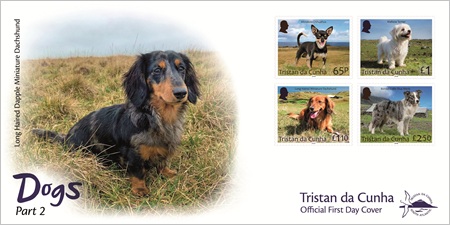
This new issue from the Tristan da Cunha Post Office is the second of a two-part series depicting the various breeds of dogs found on the island.
Dogs have been part of life on Tristan da Cunha since the very first permanent settlement, the British garrison of 1816. According to the writings of naturalist Dugald Carmichael, the early settlers used dogs to hunt the wild goats and pigs left by earlier visitors, as well as feral cats, birds, and other wildlife. They may also have helped herd livestock, though this was not explicitly recorded. These details are supported by Augustus Earle's account of his enforced stay on Tristan in 1824; Earle himself brought a hunting dog with him when he was marooned there, although no specific breeds were mentioned in his writings.
The Reverend and Mrs. Barrow, stationed on Tristan from 1906 to 1909, brought with them a Collie named Rob (originally Whisky). In her book, Katherine Barrow recounts that Rob promptly clashed with Mrs. Frances Repetto's white Fox Terrier. Barrow also notes that South African entrepreneur Casper Keytel, temporarily on the island, owned a well-bred Pointer called Scotty. She described the island's dogs as "quarrelsome among themselves," often worrying sheep, poultry, and wild birds.
A decade later, Rose Rogers, wife of another clergyman and resident in the early 1920s, referred to "a host of mongrel dogs," and described the men taking them hunting across the island's rugged terrain.
Many early family portraits from Tristan include dogs, reflecting their importance in island life. However, tragedy struck in 1961 when the volcano erupted and the entire community was evacuated. The dogs could not be taken to the UK due to quarantine and transport restrictions. Two puppies were rescued by HMS Leopard and affectionately named Tristan (a brindle bitch) and Cunha (a black dog).
Fearing that the remaining dogs might turn feral and threaten livestock, those left on the island had to be humanely destroyed before the evacuation. A few, however, escaped this fate. When the Royal Navy returned in 1962, it was discovered that the island's sheep population had been almost wiped out, most likely by the surviving dogs that had gone wild during the months of abandonment.
When the islanders resettled, they gradually reintroduced dogs, mostly Collies and Collie-crosses, which continue to serve as loyal working companions on Tristan today. These hardy working dogs help herd sheep and catch calves, especially at Stoney Beach and The Caves, and take part in the traditional Ratting Day each year.
In recent years, however, a growing number of small "pet dogs", such as Yorkshire Terriers and Dachshunds, have been imported from Cape Town, adding variety to the island's canine community.
There are currently around 100 dogs on the island, almost all of them male, as there is no breeding on Tristan and only limited capacity for neutering. Dog ownership is carefully regulated: owners must obtain a licence, secure prior approval before importing a dog, and present a veterinary health certificate on arrival. With the increasing number of companion dogs being brought from Cape Town, adherence to the island's strict importation and biosecurity rules is essential.
Veterinary services for dogs are managed by the Agriculture Department's Veterinary and Livestock Section. Although there is no qualified veterinarian resident on the island, an island-trained "vet" with basic animal-care training is responsible for treating wounds, administering pain relief, and carrying out routine worming and flea treatments. Visiting veterinarians arrive periodically to conduct general health checks, vaccinations, and other essential procedures for both working and companion dogs.
Today, most dogs roam freely during the day, though they are expected to be kept indoors at night. While occasional incidents of sheep worrying still occur, the dogs remain an enduring part of island life: loyal helpers, companions, and a living link to Tristan's earliest days.
This second set includes the following breeds, beautifully illustrated against Tristan backgrounds based on photographs by Julia Gunther:
Description of the Stamps
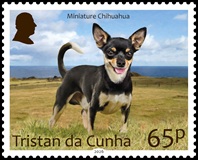
65p - Miniature Chihuahua - Miniature Chihuahuas are tiny dogs with large expressive eyes, erect ears, and a bold personality. They make fiercely loyal companions.
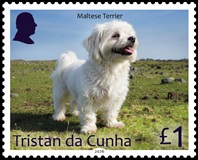
£1.00 - Maltese Terrier - Maltese Terriers are playful, intelligent, and affectionate toy dogs. They have a silky white coat, hanging ears, and a tail that curves over its back.
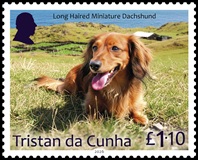
£1.10 - Long Haired Miniature Dachshund - Long Haired Miniature Dachshunds are clever hounds with a distinct, elongated, short-legged frame and silky, floppy ears and flowing coats. They have a bold and lively personality.
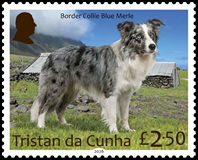
£2.50 - Border Collie Blue Merle - Like all Border Collies, Blue Merles are highly intelligent herding dogs, featuring a distinct marbled grey-and-black coat and bright blue eyes.
FDC - Long Haired Dapple Miniature Dachshund - Long Haired Dapple Miniature Dachshunds are distinguished from other long haired Dachshunds by their marbled coat pattern.
Technical Specifications
| Photography: | Backgrounds based on photographs by Julia Gunther | ||
| Design: | Andrew Robinson | Stamp size: | 38 x 30.6mm |
| Printer: | Cartor | Perforation: | 13¼ x 13 per 2cms |
| Process: | Stochastic Lithography | Layout: | 10 |
| Production Co-ordination: | Creative Direction (Worldwide) Ltd | ||