
Postscript to the Hantavirus Outbreak
Summary from Philip Kendall and Kelly Green
The World Health Organisation (WHO) announced on the 2nd July 2026 that the worldwide outbreak of the Andes hantavirus arising from the MV Hondius had ended, as all identified contacts had completed the WHO recommended 42 day isolation periods under the supervision of their respective national health authorities. The civilian medical team sent to help Tristan from the Falkland Islands departed on the MFV Edinburgh on the 3rd July, thus enabling Tristan to finally draw a line under the outbreak.
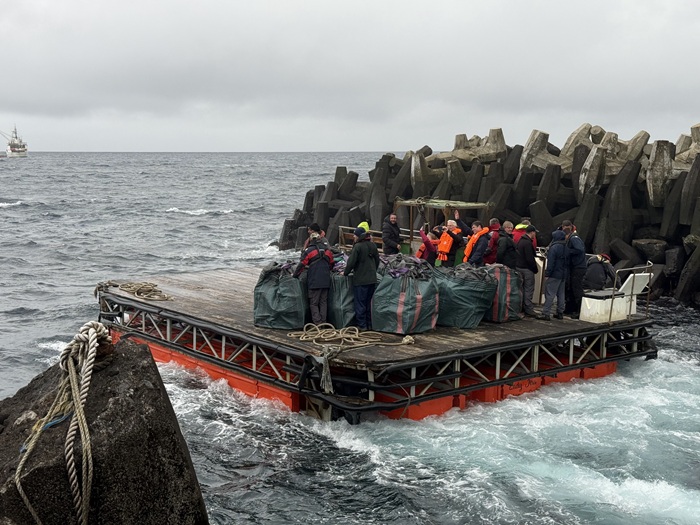
UK-MED, Iqarus and Falkland Island medics head out to the Edinburgh at the end of their mission. Photo: Philip Kendall
The current consensus is that the initial infection was acquired by two passengers on land in South America, before they embarked the MV Hondius. Although the first fatality occurred, before the ship visited Tristan, there was no undue cause concern until further cases emerged and two more people died shortly after her call at St Helena. The virus was then identified and measures quickly put in place to stop the spread of infection. Unfortunately, there had been an exchange of island passengers at Tristan, and a number of the cruise passengers had disembarked at St Helena for onward travel. Add the international make-up of the passenger list, this turned this a worldwide issue.
Fortunately, the WHO-recommended action plan successfully contained the outbreak. In total, there were 13 cases, including one Tristanian. However, there were also 317 high risk contacts who were kept in isolation for 42 days and 336 lower risk contacts, some of whom needed to self isolate. These were spread across 33 countries, with one person having travelled as far away as Pitcairn Island.
The response of the UK Government and British Armed Forces to Tristan's call for medical help, including the historic airdrop has already been reported on this website and elsewhere. The island will be eternally grateful.
The reaction of Hondius passengers to their predicament seems generally to have been positive. They have mostly been happy with the way the MV Hondius and their home countries handled things once the nature of the outbreak had been identified, given that the Andes virus was effectively a new disease. Several passengers have said that they would travel on the Hondius again.
With the departure of the medics on the MFV Edinburgh, Tristan is back where it was before the outbreak, and we are looking forward the next cruise season, which is scheduled to start with a visit the SH Diana in October. The Hondius has been deep cleaned, and we are confident that all the cruise companies will have learned from this episode. Expedition cruises were already very careful with biosecurity, and we are sure will have extra precautions in place to avoid a recurrence of further outbreaks.
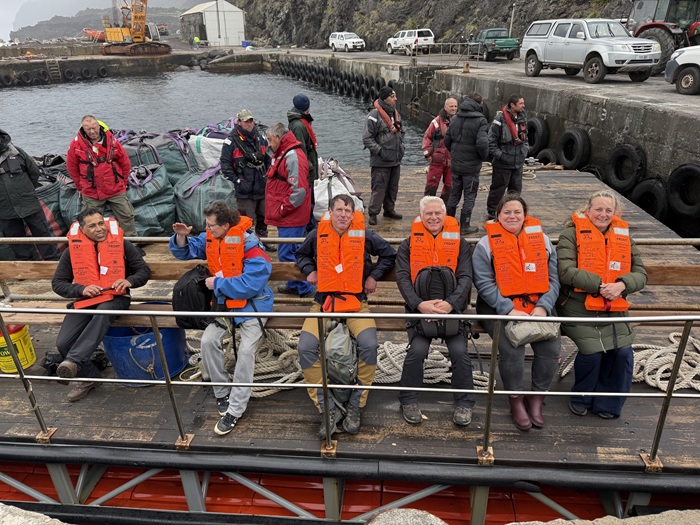
The medical sitting on the raft waiting to leave Calshot Harbour. Photo: Philip Kendall
PPS
Elsewhere, we have reported on the storm that hit Tristan on the 7th July 2026, which caused a significant amount of damage. We are confident that this will not affect the forthcoming cruise season. There was no damage to the harbour, and there was only slight damage to the Post Office and Tourism Centre, the Albatross Bar and other attractions. This will all have been fixed long before the cruise ships are due.