
Details of the Daring Airdrop at Tristan da Cunha, 9th May 2026
Report compiled by Peter Millington. Photos and quotes individually credited.
Following requests from the respective Administrators and the Governor, the UK Government decided to provide support to the UK Overseas Territories affected by the recent outbreak of hantavirus on the cruise ship MV Hondius.

An RAF aircraft flying low over the settlement, photographed by Odile Cesari from the 1961 volcano. This is an unprecedented sight, as the rare planes that fly over Tristan do so at high altitude and are often hidden from view by the island's low clouds.
The Hondius visited Tristan and landed visitors in mid-April during the voyage's three day stop at the island. An islander who disembarked at Tristan subsequently became ill with suspected hantavirus and was isolated in the care of the island's hospital. However, the hospital is small, and medical oxygen and other supplies were soon running low.
The Ministry of Defence was therefore asked to fly military personnel and medical supplies to Tristan to relieve the hard-pressed hospital staff on the island. This is not a logistically routine matter. There is no airstrip on Tristan, so, support would have to be parachuted in. Additionally, to complicate matters, Tristan is very windy and weather conditions change rapidly, making it very challenging for paratroopers.
Preparation and Planning
Tristan is famously the remotest inhabited island in the world. It is 1,510 miles (2,430 km) from the neared airport, which is on St Helena, and the nearest British military air base is at Ascension Island - 2,010 miles (3,235 km) away. Few military transport aircraft have the necessary range, and those that do would need in-flight refuelling. Clearly, serious planning was needed.
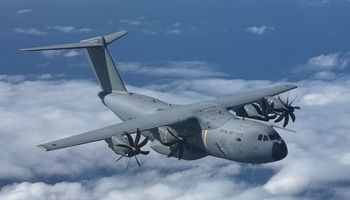
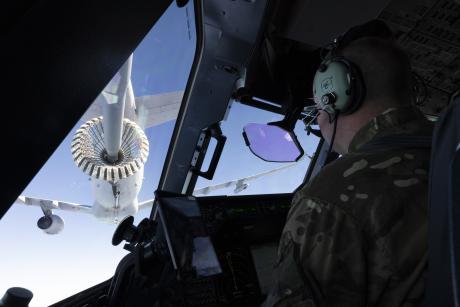
An RAF Airbus A400M transport plane was selected as the most suitable aircraft for the drop, to be deployed in conjunction with a Voyager air-to-air refuelling (AAR) tanker.
 |
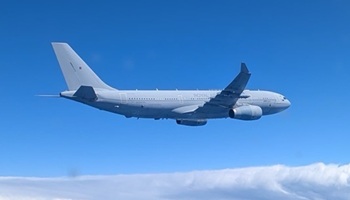 |
| A400M Atlas transporter. Photo: Ministry of Defence | Voyager AAR tanker viewed from the A400M Photo: RAF |
Brize Norton and Ascension Island
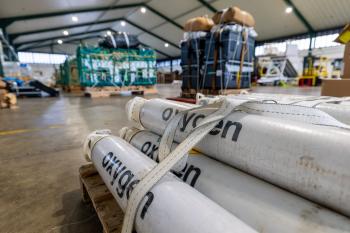
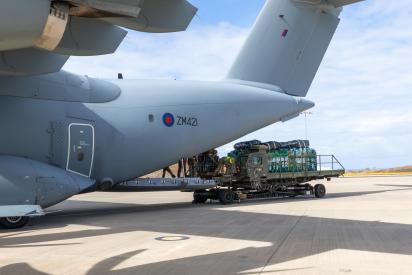
The medical supplies, the personnel and their kit were assembled at RAF Brize Norton and loaded onto the A400M. They then flew 4,218 miles (6,788 km) to Ascension Island to rendezvous with the AAR tanker in readiness for the final leg of the journey.
 |
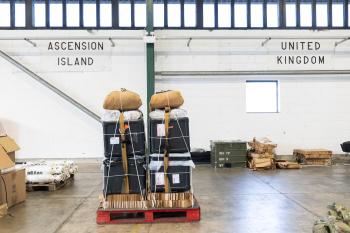 |
| Palettes of medical oxygen and kits ready for loading at Brize Norton and Ascension. Photos: MoD | |
 |
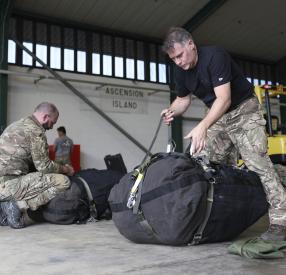 |
| Loading palettes onto the plane at Ascension. | PJIs at Ascension checking the Paratroopers' bergens are securely fastened. |
Details of the Flight
Early on Saturday 9th May, it was decided that the operation could go ahead. The Administrator, Philip Kendall, issued a Public Notice to the islanders announcing the operation and telling them to be ready for arrival at about 3:30pm, and suggested having their cameras with them.
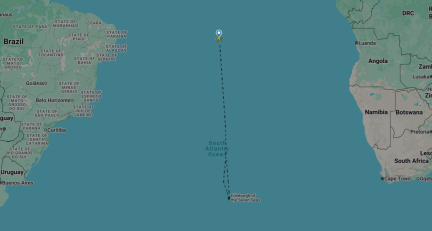
The A400M (Flight RRR4989) took off from Ascension just before midday and headed directly to Tristan. The plane refuelled en route half way. In the event, adverse winds meant that arrival was delayed until about 5:00pm.
 |
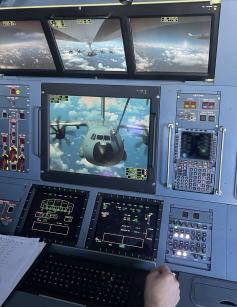 |
| The A400M pilot's view of the refuelling operation Photo: MoD | Voyager's control panel during the operation. Photo: RAF |
The plane flew between Inaccessible and Tristan to the south west of the island, and then turned to make airdrop passes over the settlement plain.
 |
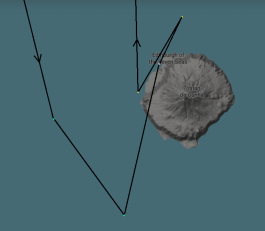 |
| The A400M's flight path in the South Atlantic from Ascension to Tristan, and its movements while at Tristan. Maps adapted from FlightRadar24 |
|
The Airdrops
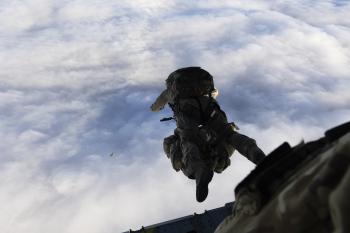
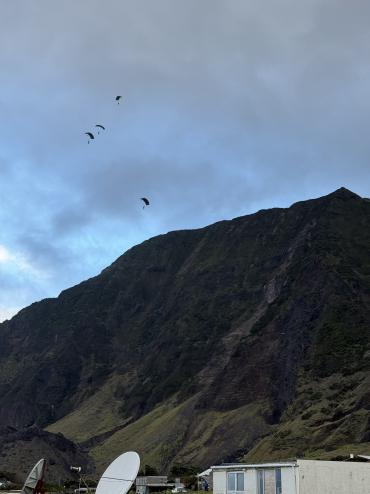
The chosen personnel were a British Army Pathfinder Platoon belonging to the 16 Air Assault Brigade and consisted of six paratroopers and two passengers - a consultant doctor and an ICU military nurse. They were parachuted at high altitude from the aircraft at the start of the operation in two groups. This was no mean feat given Tristan's unpredictable winds and the minimal leeway between the cliffs and the sea. They jumped from 3 miles (5 km) out over the sea at a height of 7,000 ft (2,134 m), drifting backwards in the wind. The first group landed safely near the Back Fence, while the second group landed on the 9-hole golf course next to the settlement. The Police RIB had been launched as a precaution, in case any of the parachutes failed to reach land. Fortunately, they all did.
Video of the first group of paratroopers leaving the ramp at the rear of the aircraft. Video: Ministry of Defence
 |
|
 |
|
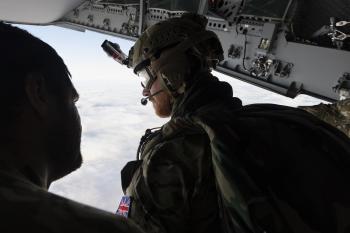
| Paratrooper awaiting the order to jump and the video from his helmet camera. Photos: Ministry of Defence | |
 |
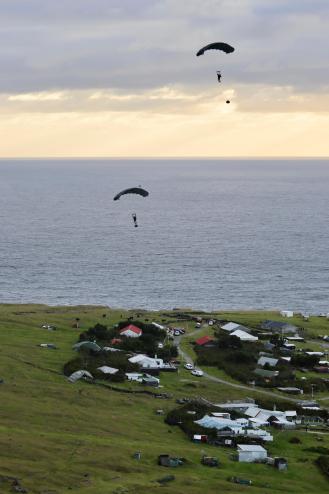 |
| View from the ground as the paras appear above the cliffs. Photo: Philip Kendall | View from the 1961 volcano of the about to land near the Back Fence. Photo: Odile Cesari |
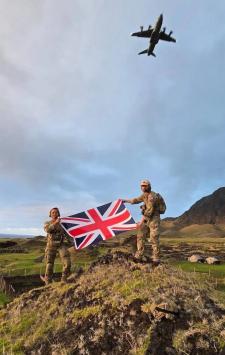
Members of the first group were transported to the Patches, where they took up position on one of the mounds there to guide the aircraft by radio during its subsequent runs.
 |
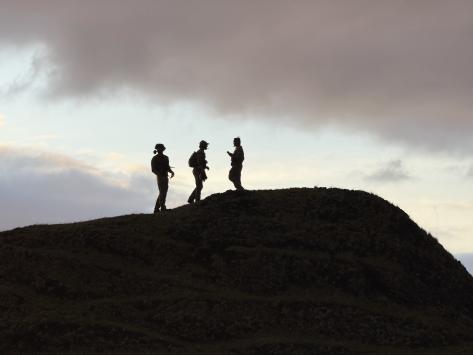 |
| Two parachutists holding a Union flag at the Patches Photo: Ministry of Defence | Men of the first group at the Patches, where from the top of one of the mounds they guided in the aircraft for cargo drops. Photo: Philip Kendall |
The medics were dropped onto the island's 9-hole golf course during the second run using tandem parachutes.
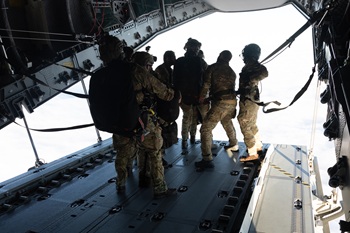 |
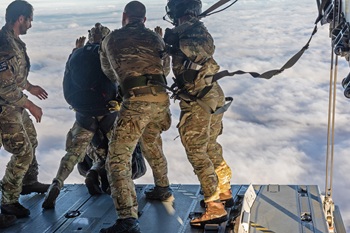 |
| Tandem parachutists lined up and leaving the ramp. Photos: Ministry of Defence | |
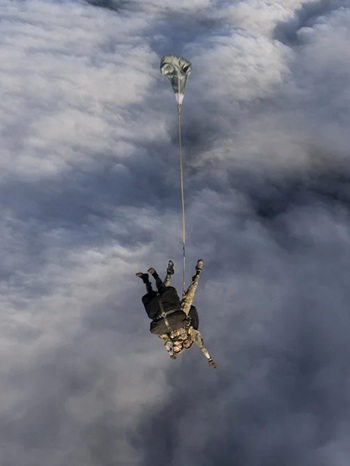 |
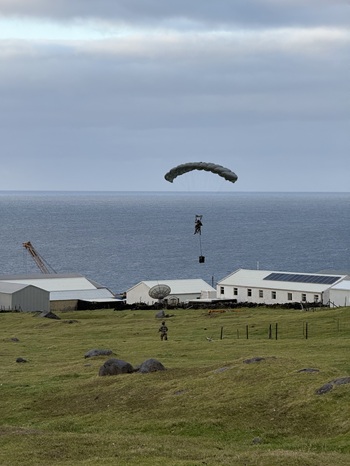 |
| The tandem jump with the ICU Nurse in midair. Photo: Ministry of Defence |
Tandem parachutists landing at the golf course. Photo: Philip Kendall |
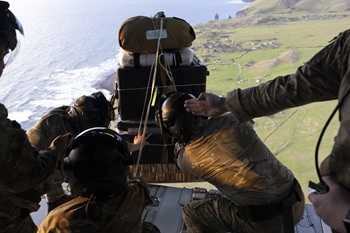
The 3.3 tonnes of palleted cargo were successfully dropped in three batches at the Patches. For these, according FlightRadar24, the plane flew at an altitude of just 175 ft and a speed of 162 knots.
 |
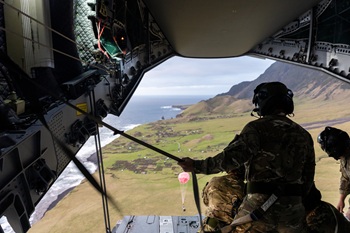 |
| RAF Movers dispatch one of the pallets of medical supplies and watch it descend. Photos: Ministry of Defence | |
Plane flying over the settlement to drop cargo at the Patches, filmed from the 1961 volcano by Odile Cesari
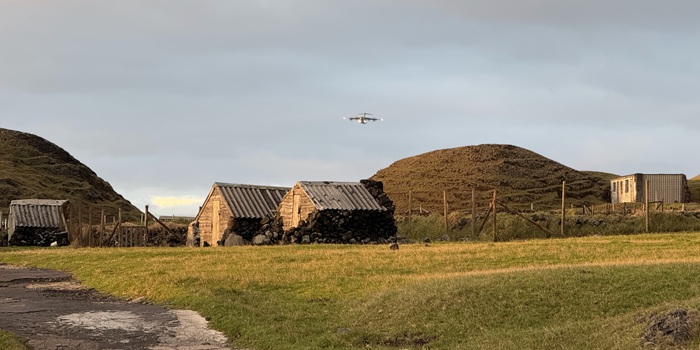
The view from the Patches as the A400M approaches from Hillpiece at low altitude. Photo: Philip Kendall
 |
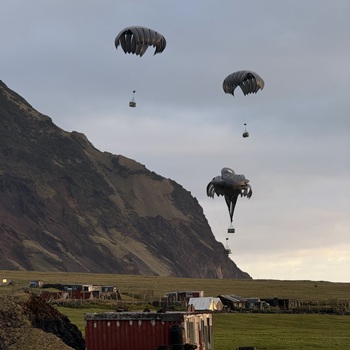 |
| The aircraft dropping cargo at the Patches. Photos: Kelly Green & Philip Kendall | |
Wrapping Up
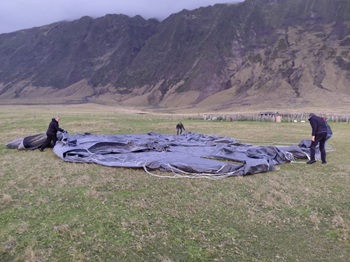
It should be born in mind that it is winter in Tristan and towards the end of the operation it was starting to get dark. It was a close run thing completing the drops while there was still sufficient daylight. Islanders picked up the cargo and parachutes and transported them into the settlement, all except for the final load, which had to be left until the next morning.
 |
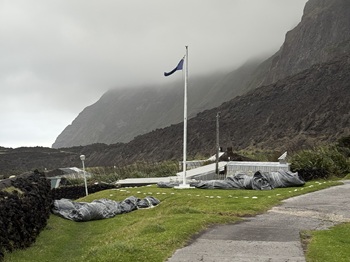 |
| Tristan expats folding a cargo parachute. Photo: Chloe Glass | Parachutes stacked by the flagpole. Photo: Philip Kendall |
The military team received a typical Tristan welcome. They were fed and watered, and assigned to accommodation guest houses. Knowing Tristan hospitality, they may well return home a few pounds heavier than when they came. They afterwards set up base in Prince Philip Hall, where they soon settled in.
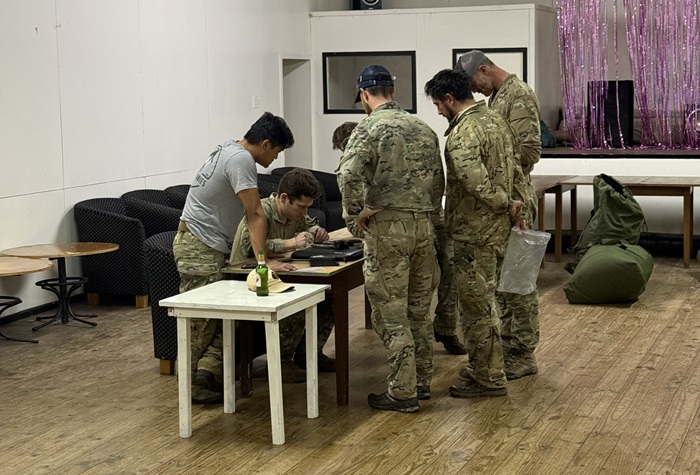
The team setting up base in Prince Philip Hall. Photo: Philip Kendall
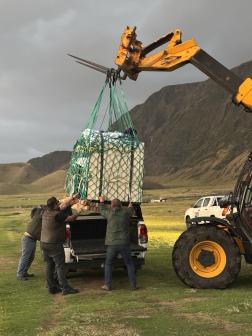
At the break of day on Sunday 10th May, the final load was brought to the Camogli Hospital in the settlement, and everything was unpacked.
 |
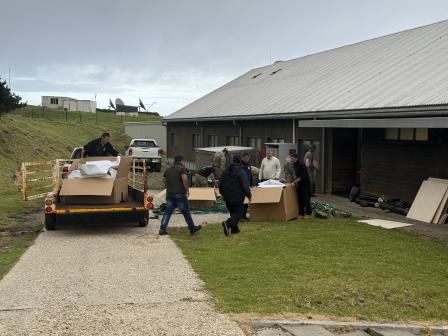 |
| Islanders picking up the supplies using the telehandler and unpacking at the hospital. Photos: Kelly Green & Philip Kendall | |
The doctor and ICU nurse quickly got to work, providing much needed respite for Tristan's hospital team, who have been overstretched caring for the suspected hantavirus case as well as their usual medical duties. At the time of writing, we understand that the patient is stable, and for the moment, this is where our story takes a break.
Islanders' Reactions
The first thing to say is that all the Tristanians and their relatives and friends overseas are incredibly grateful to the UK Government, the FCDO and Ministry of Defence for the trouble they are taking to the support the community during the current outbreak. They are equally grateful to the servicemen who so bravely and skilfully jumped to their rescue.
The Administrator, Philip Kendall said:
"This was an amazing combined effort from the UK armed forces, the FCDO, MoD, UKHSA and our strong Tristan community. Thank you everyone! A truly historic day."
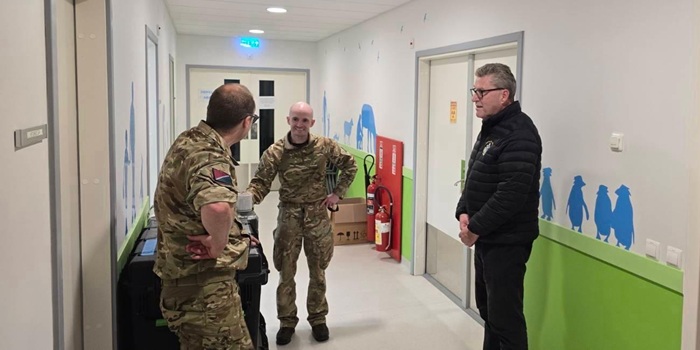
Philip Kendall personally thanking the MoD medics. Photo: Ministry of Defence
The islanders' second reaction has been complete amazement at the intrepid feat the Army and Air Force achieved during this operation. It was almost enough to make them forget the reason for it. Fixed wing aircraft have never ever flown low over Tristan, and it follows that have parachutes have never been seen there either.
The islanders are also very grateful for all the prayers and messages of support they have received from hundreds of well-wishers around the world.
What Next?
The team has already set to work on the mission they were sent for. As it is early days, we will report on this at a later date, but we know that the world wishes them every success. When their work is done, they will leave the island by ship.
And Finally...
We will leave the last word to the island's policeman, Barry Thacker, who was moved to write the following poem as he wound down at the end of a very busy day, dedicated to all the amazing people who made History happen:
|
On windswept shores where oceans foam, Across the vastness the RAF flew through, Tristan da Cunha, proud and small, Praise for Andrew, Mark, and Larry too, Andy and Nicky key on comms, Philip, Craig, and Barry led the way, Chloe and Kelly captured the scene, And blessings too for every cook, |
 |
|
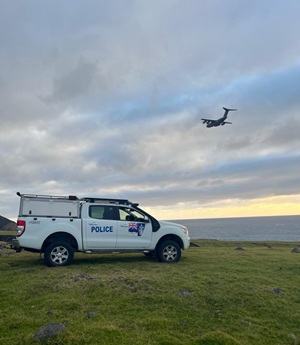
| The police vehicle with A400M flying overhead, Photo: Barry Thacker |
||
|
Then finally perhaps the loudest cheer And thanks across the sea must go So here’s to all who played their part, |
Further Information
Ministry of Defence, Military conducts daring parachute drop to deliver critical medical support to Tristan da Cunha, 10th May 2026
BBC, Army parachutes onto remote island to help Briton with suspected hantavirus, 10th May 2026
BBC, Watch: Soldier on parachuting to remote island to bring Hantavirus aid, 11th May 2026