Celebrating the 50th Anniversary of Islanders return to Tristan
|
On Sunday 10th November 2013 we celebrate the 50th Anniversary of the safe return of Tristan da Cunha Islanders as on 10th November 1963 MV Bornholm arrived at the island with the final and main party of returnees. |
|
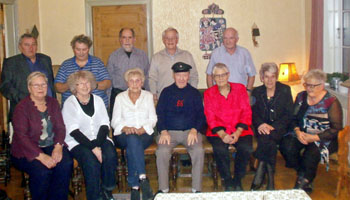
MV Bornholm Crew celebrate the 50th Anniversary To coincide with the anniversary of the safe return of Photo from Troels Riis Jørgensen |
 |
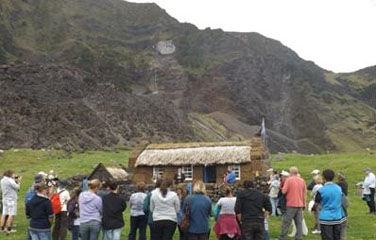 |
November 2013 RMS St Helena Voyage RMS St Helena's cruise to Tristan da Cunha
|
|
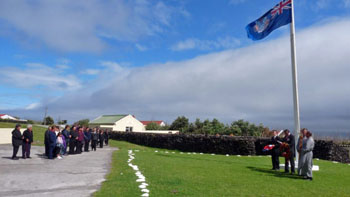
Remembrance Day Service and Wreath Laying Ceremony also celebrates 50th Anniversary See Church News Page for details and more photos. |
 |
|
|
|
|
|
|
|
|
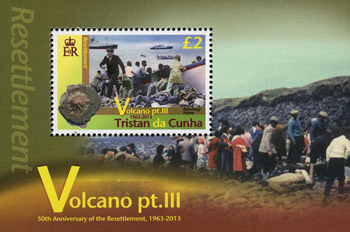
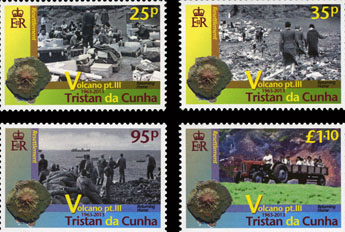
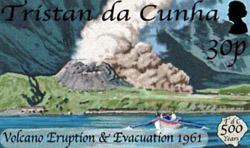
The Tristan da Cunha Post Office has issued a series of stamps commemorating the events of 1961-63. Those above show scenes after the arrival of MV Bornholm in November 1963 Visit the Tristan Post Office for details
|

|
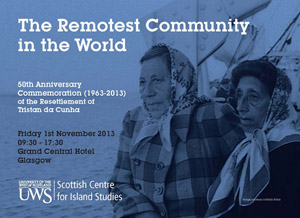
An event was organised in Glasgow Go to the Glasgow Tristan Event page for report and photos |
 |
|
Tristan da Cunha Association book to celebrate the 50th Anniversary As announced in the August 2013 Tristan Newsletter the book project continues but publication is delayed and further news of it will be published in 2014. The response from Tristan Islanders and many others has been fantastic, and justice needs to be done to a vast archive, much of it unpublished, to attempt to set the record straight of the central events in 1961-63 which defined the history of the island community. Work continues to check and verify facts, and to create both a book that it is hoped will be of interest to the general reader, and a second detailed chronicle may be made available in digital form to Tristan Association members buying the book for their own records. |
|
|
October 2011 was the 50th anniversary This page is designed to give a summary of the remarkable sequence of events which culminated in the successful return of the resolute community to their South Atlantic home in 1963. |
|
|
|
|
|
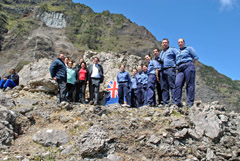
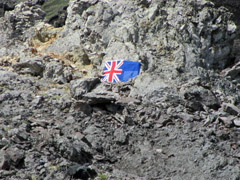
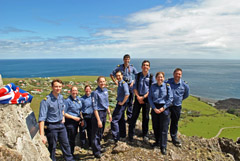
Commemorating the 50th Anniversary of the volcanic eruption and evacuation Photos show the plaque which was unveiled on this day and the party of crew members, Islanders and Expatriates present. Peter was a founder member of the Tristan da Cunha Association I send my warmest greetings to you all. May I share with you, for a moment or two, that extraordinary chain of events which unfolded for us all 50 years ago. Think back (if you were old enough then) to early October 1961 when the weather and the sea were both bad. We hadn't seen a ship for weeks until, a few days earlier, the two fishing ships had arrived at the start of their fishing season. Meanwhile back on land things had not been easy for some time with earth tremors, bumps and rock falls, in and around the village, increasing in number and intensity day by day. Nobody knew for certain what was happening deep down beneath us. Even the experts from England and South Africa could only guess - wrongly as it turned out! There wasn't much we could do ourselves except cross our fingers and hope for the best! We did however manage to establish that whatever was going on was happening right underneath us! This was not only extremely unlucky, but also extremely lucky as well - bad luck because we might have had to get out of the way very quickly indeed if things going on below ever came to the surface, and good luck because there were probably places we could escape to if necessary. As it was, we just had to wait and see; but not for long, for on October 9th a spot on the grassy slope near the houses split, with one half rising some 10 feet above the other. What was it - the beginnings of a volcanic eruption or what? It wasn't at all clear! Common sense dictated that we should get out of the way and that night we slept, as best we could, at the Patches. Meanwhile, out at sea the two fishing vessels rode at anchor opposite to us and in the middle of the night, Scottie seeing the start of an eruption, sent up flares to warn us. Mercifully, we slept on and were not tempted to try to evacuate to the ships in the dark. Mercifully too, when daylight arrived, the sea was calm and with the new volcano growing quietly we were able to leave from Little Beach without anyone so much as spraining an ankle. Up to this point our biggest lucky break was that the new eruption grew slowly and didn't explode hurling rocks high into the sky. If it had exploded I am sure that none of us would be around today! Being blessed with good fortune during the evacuation itself right up to the eventual return to the Island, good luck stayed on, as one after another the jigsaw pieces fell into place during the days and months that followed. The sea was calm, the volcano didn't explode, an empty liner was crossing the Atlantic, another liner on its way to Southampton was waiting in Cape Town, the Army lent us some barracks and the RAF gave up no less than sixty four of their houses in Calshot and then, most important of all, in Cape Town and in England we were surrounded by kindness and real sympathy with people falling over backwards to be helpful. And then finally the best bit by far. All those hundreds of miles away on Tristan the eruption stopped and it was safe to return. Martha Rogers summed it all up beautifully when she said:- "We was meant to leave and now we is meant to go home" God be with you and the Island too. Peter Wheeler October 2011 |
||